

Rating scales
My rating scales can all be downloaded from here and can be used without my permission so long as you cite the scale in any publication.
Scholars who wish to translate a scale into another language should check whether it has already been translated on the list below and arrange an independent back translation to check on the accuracy. Scholars are encouraged to follow best practices for scale translation and validation (see Swami & Barron, 2019; Swami, Todd, & Barron, 2021).
Scales on this page
Appearance Anxiety Inventory
The Appearance Anxiety Inventory (AAI; Veale et al., 2013) is a 10-item measure used to assess cognitive processes (eg rumination, self-focused attention) and behavioural responses (eg avoidance , checking) in people with Body Dysmorphic Disorder (BDD). The AAI is derived from a theoretical model of BDD (Veale, 2004) and measures appearance anxiety as it relates to the cognitive behavioural model of BDD. It is sensitive to change as an outcome measure for treating BDD in adults (Veale et al., 2014) and in adolescents (Mataix-Cols et al., 2015; Gumpert et al., 2024) It was designed to assist clinicians as a process measure to track progress during therapy . Despite this it has become widely used as a measure of appearance anxiety and body image in people without BDD.
Psychometrics: Individuals respond to items on a 5-point Likert Scale (0= not all to 4= all the time) and a total score is obtained by summing all the items (range is 0 to 40). The reliable change score is 7 and above. Caseness for BDD is a score of 19 or above.
Factor structure: Two factors were identified in a clinical sample (Avoidance sub-scale items 1, 3, 5, 7, 9, 10) and Threat Monitoring sub-scale (items 2, 4, 6, 8) (Veale et al, 2014). Three factors were identified in a clinical sample (“threat monitoring”, “camouflaging”, and “avoidance”) (Gumpert et al, 2024). One factor was found in a non-clinical sample which will have a reduced variance (Roberts et al, 2018)
Sensitivity to change: A reduction ≥ 40% on the AAI was the optimal cut-off for treatment response. An AAI score ≤13 was the optimal cut-off for full or partial remission (Fygare et al, 2020).
The scale can be used without my permission so long as you cite the scale in any publication.
Download the Appearance Anxiety Inventory
Dutch translation of the AAI; German translation; Indonesian translation; Italian translation; Japanese translation; Polish translation; Portugese translation; Swedish translation; Urdu translation
References
Flygare, O, et al (2020) Empirically defining treatment response and remission in body dysmorphic disorder using a short self-report instrument. Behavior Therapy, https://doi.org/10.1016/j.beth.2020.10.006
(2024) Psychometric evaluation of the appearance anxiety inventory in adolescents with body dysmorphic disorder, Cognitive Behaviour Therapy, 53:3, 254-266, DOI: 10.1080/16506073.2023.2299837
Mastro, S, et al (2016) Young adolescents’ appearance anxiety and body dysmorphic symptoms: Social problems, self-perceptions and comorbidities,Journal of Obsessive-Compulsive and Related Disorders, 8, 50-55, https://doi.org/10.1016/j.jocrd.2015.12.001
Noda, C, et al (2025). Cross-cultural network structures of social anxiety, body dysmorphic, and major depressive disorder symptoms in individualistic vs. collectivistic societies: A comparison between American, German, and Japanese populations, Journal of Anxiety Disorders, 116, 103090. https://doi.org/10.1016/j.janxdis.2025.103090 Validation of the AAI in German and Japanese populations.
Roberts, C., et al (2018). The appearance anxiety inventory: Factor structure and associations with appearance-based rejection sensitivity and social anxiety. Journal of Obsessive-Compulsive and Related Disorders, 19, 124-130. https://doi.org/10.1016/j.jocrd.2018.10.004
Veale, D, et al (2014). The Appearance Anxiety Inventory: Validation of a process measure in the treatment of body dysmorphic disorder. Behavioural and Cognitive Psychotherapy. 42: 605–616 http://dx.doi.org/10.1017/S1352465813000556
Van Rood, Y.R, et al (2023) Development of a body dysmorphic disorder screener for DSM-5 (BDDS-5). Comprehensive Psychiatry, 127, 152416, https://doi.org/10.1016/j.comppsych.2023.15241(Validation of Dutch AAI against screening measure for BDD)
Yurtsever, I., et al (2022). Appearance Anxiety Inventory (AAI): creation and validation of the Polish language version. Advances in Dermatology and Allergology/Postępy Dermatologii i Alergologii, 38 (1). https://doi.org/10.5114/ada.2021.112767
Cosmetic Procedure Screening Scale (COPS) or Body Image Questionnaire
The Cosmetic Procedure Screening Questionnaire (COPS) (also called the Body Image Questionnaire in non-cosmetic settings) is designed to screen for Body Dysmorphic Disorder. It is used as an outcome measure in the treatment of BDD. There are two versions.
1) A weekly 9 item version adopted by the NHS Talking Therapies as an outcome measure. The items are scored from 0 (least impaired) to 8 (most impaired). The score is achieved by summing all the items. Items 1, 2 and 4 are reversed (that is if the person circles “8” then this is a score of zero, circling “7” is scored as ‘1’ and so on). The total scores range from 0 to 72 with a higher score reflecting greater impairment and symptoms of BDD. Individuals who score 40 or more are likely to have a diagnosis of BDD (“caseness”). Reliable change score is >10. It can be used without my permission so long as you cite it in any publication.
Download the weekly BIQ as used in the NHS Talking Therapies.
2) A 10 item version used for assessment in a specialist service in which the first item is disregarded in the scoring. Items 2, 3 and 5 are reverse scored. The total scores range from 0 to 72 with a higher score reflecting greater impairment and symptoms of BDD. The scores for baseness and reliable change are the same as the for the weekly version. The factor structure of the COPS has been examined in both adult clinical and community samples, finding evidence for its one-dimensionality (i.e., single factor structure). There is also a version for adolescents (Blacker et al, 2024; Schneider et al, 2018) . There is an Arabic, Greek and Polish translated versions. The BIQ/COPS can be used without my permission so long as you cite it in any publication.
The longer adult BIQ/ COPS used for assessment
Arabic translation of COPS/BIQ; Greek translation; Polish translation
Reference
Al Arfaj, A. M., Al Otaibi, T. M., Obeid, A. A., Alkhunaizi, A. A., Subhan, Y. S., & Al Arfaj, A. (2016). 1. Development validation and testing of an arabic version of the cosmetic procedure screening questionnaire COPS for body dysmorphic disorder. Kuwait Medical Journal, 48(1), 38-41. https://faculty.ksu.edu.sa/sites/default/files/dev_validation_bdd.pdf
Bala, M, Quinn, R, Jassi, A, Monzani, B, Krebs, G (2021). Are body dysmorphic symptoms dimensional or categorical in nature? A taxometric investigation in adolescents. Psychiatry Research, 305, 114201. https://doi.org/10.1016/j.psychres.2021.114201
Blacker, L., Gupta, M., Quinn, R., Monzani, B., Jassi, A., Veale, D., Mataix-Cols, D. & Krebs, G. (2024). A psychometric evaluation of the Body Image Questionnaire Child and Adolescent Version. Child Psychiatry Hum Dev. https://doi.org/10.1007/s10578-024-01768-1
Kallianta, A., Bacopoulou, F., Vlachakis, D., Kokka, I., Chrousos, G. P., & Darviri, C. (2021). Validation of the Cosmetic Procedure Screening (COPS) Questionnaire in the Greek language. EMBnet. journal, 26. http://dx.doi.org/10.14806/ej.26.1.971
Schneider, S. C., Baillie, A. J., Mond, J., Turner, C. M., & Hudson, J. L. (2018). Measurement invariance of a body dysmorphic disorder symptom questionnaire across sex: The Body Image Questionnaire–Child and Adolescent Version. Assessment, 25(8), 1026-1035. https://doi.org/10.1037/t70957-000
Veale, D, Ellison, N, Werner, T, Dodhia, R, Serfaty, M & Clarke, A. (2012) Development of a cosmetic procedure screening questionnaire (COPS) for Body Dysmorphic Disorder. Journal of Plastic Reconstructive and Aesthetic Surgery, 65:530-532. http://dx.doi.org/10.1016/j.bjps.2011.09.007
Download the COPS 2012 paper
Download the extended version of the COPS 2012 paper
Yurtsever, I., Matusiak, Ł., Szepietowska, M., Wójcik, E., Veale, D., & Szepietowski, J. C. (2021). Cosmetic Procedure Screening Questionnaire (COPS): creation and validation of the Polish language version. Postepy dermatologii i alergologii, 38(5), 881–886. https://doi.org/10.5114/ada.2020.96704
Self As Aesthetic Object (SAO)
Processing of the Self as an Aesthetic Object (SAO) is a theoretical model for understanding the experience of body dysmorphic disorder. It refers to the way individuals with BDD intensely focus on their feature(s) as a defining aspect of their identity. It is driven by distorted and negative imagery and uncertainty of how they appear to others. It is associated with the experience of shame and anticipation of negative evaluation and rejection. This perception is often influenced by past aversive memories. As a result, individuals may interpret their perceived flaws as a threat to their entire sense of self, leading to safety seeking behaviours such as ruminating, comparing, mirror checking, avoidance, or cosmetic procedures to reduce the sense of threat. Unsurprisingly, these solutions (as measured on the Appearance Anxiety Inventory) become the problem, reinforcing the cycle of self-focused attention, preoccupation and distress.
Download the SAO questionnaire
References
Baldock E., & Veale D., (2017). The self as an aesthetic Object: a model of cognitive processing in Body Dysmorphic Disorder. In Phillips, K.A (Ed.), Body Dysmorphic Disorder: Advances in Research and Clinical Practice Oxford University Press, USA. ISBN-13: 9780190254131 https://oxfordmedicine.com/view/10.1093/med/9780190254131.001.0001/med-9780190254131
Veale, D, Hutton, M, Papageorgiou, A, Jegelka, L, Baldock, E. (2025) Self as an aesthetic object: development of a new process measure for body dysmorphic disorder. Body Image, 54:101950. https://doi.org/10.1016/j.bodyim.2025.101950
Penile Dysmorphic Disorder Screening Scale
Penile Dysmorphic Disorder is shorthand for men diagnosed with Body Dysmorphic Disorder (BDD), in whom the size or shape of the penis is their main, if not their exclusive, preoccupation causing significant shame or handicap. The Penile Dysmorphic Screening Questionnaire is therefore designed to screen for BDD in such men. It comprises of 9 items. Items are scored from 0 (least impaired) to 8 (most impaired). Items 1 and 3 are reversed scored (that is if the person circles “8” then this is a score of zero, circling “7” is scored as ‘1’ and so on). The total scores range from 0 to 72 with a higher score reflecting greater impairment and symptoms of BDD. It can be used without my permission so long as you cite it in any publication.
Download the Penile Dysmorphic Disorder scale (COPS-P)
Reference
Veale, D, Miles, S, Read, J, Miles, S, Troglia, A, Phillips, R, Carmona, L, Fiorito, C, Wylie, K, Muir, G. (2015). Penile Dysmorphic Disorder: Development of a screening scale. Archives of Sexual Behavior, 44(8) 2311-2321. http://dx.doi.org/10.1007/s10508-015-0484-6
Download the COPS-P 2015 paper
Beliefs about Penis Size
The BAPS is a 10-item self-report scale that measures beliefs about masculinity and shame about penis size. Two of the items measure internal self-evaluative beliefs, such as feeling abnormal (e.g., “I will never feel just right”). Three items describe a social cognitive component with predictions such as “Others will talk about my penis or laugh at it”. There are four items on anticipated consequences of a small penis size, such as having to avoid situations where they may be naked (e.g., “I will not be able to be naked in front of women”). Lastly, there are two items on extreme self-consciousness (e.g., “Others will be able to see the size or shape of my penis even when I have my trousers on”). The participant is asked to rate how strongly he agreed or disagrees with each statement, using a 5-point Likert scale from 0 (“Strongly disagree”) to 4 (“Strongly agree”). Total scores range from 0 to 40. A higher score therefore represents a greater level of insecurity and shame about penis size. Cronbach’s alpha for the scale was .95, indicating strong internal reliability.
It can be used without my permission so long as you cite it in any publication.
Download the Beliefs About Penis Size questionnaire
References
Veale, D, Eshkevari, E, Read, J, Miles, S, Troglia, A, Phillips, R, Carmona, L, Fiorito, C, Wylie, K, Muir, G. (2014) Beliefs about penis size: validation of a scale for men ashamed about their penis size. Journal of Sexual Medicine, 11: 84-92. http://dx.doi.org/10.1111/jsm.12294
Cosmetic Procedure Screening for Labiaplasty
The Cosmetic Procedure Screening for Labiaplasty (COPS-L) is designed to screen for Body Dysmorphic Disorder and comprises of 9 items. Items are scored from 0 (least impaired) to 8 (most impaired). Item 2 is reversed scored (that is if the person circles “8” then this is a score of zero, circling “7” is scored as ‘1’ and so on). The total scores range from 0 to 72 with a higher score reflecting greater impairment and symptoms of BDD. Individuals who score 45 or more are likely to have a diagnosis of BDD. Limited research so far suggests that having mild-moderate BDD about ones genitalia in women is not by itself a reason for refusing a labiaplasty (Veale et al 2014), Note that the instructions focus on the respondent’s views about their genitalia (and not other part of their body). The COPS-L can be used without my permission so long as you cite it in any publication.
Download the COPS-L questionnaire
IF you are using the COPS-L, I also recommend the Genital Appearance Scale (GAS) by Bramwell & Morland (2009) for audit and outcome monitoring of interventions for women distressed by the appearance of their genitalia. The GAS has an advantage in assessing additional functional symptoms in such women. This scale contains 11 statements about attitudes towards female genital appearance to be rated by a woman. Each item is scored between 0 and 3 and total scores range from 0 to 33. Higher scores represent greater dissatisfaction with the genitalia. The general population sample for the original study had mean 5.65 (SD 4.68) (Bramwell, personal communication). In our study validating the COPS-L, women seeking labiaplasty had a mean and standard deviation of M=38.7 (SD=15.1) and the controls M=6.7 (SD=7.4). Note that items 1 and 4 are reverse scored. There is a mistake in the instructions in the original paper, which states items 1,4 and 8 are reverse scored. This was confirmed to me by Professor Bramwell in a personal communication). Please note I do not hold copyright permission for the GAS and you must approach Professor Bramwell to use her scale.
References
Bramwell, R. and C. Morland, Genital appearance satisfaction in women: the development of a questionnaire and exploration of correlates. Journal of Reproductive and Infant Psychology, 2009. 27(1): p. 15-27. https://doi.org/10.1080/02646830701759793
Goodman, M. P. (editor), Placik, O., Matlock, D., Simopoulos, A., Moore, R., Cardozo, L., Miklos, J., Goldstein, A., Veale, D., Stern, B., Bowers, M., Goldstein, G. (associate editors) (2016). Female Genital and Plastic Surgery.Wiley-Blackwell. ISBN: HB 978-1118848517
Veale, D, Eshkevari, E, Ellison, N, Cardozo, L, Robinson, D, & Kavouni, A. (2013). Validation of Genital Appearance Satisfaction Scale and COPS-L. Journal of Psychosomatic Obstetrics and Gynecology, 34(1): 46–52. http://dx.doi.org/10.3109/0167482X.2012.756865 Download the paper
Veale, D., Eshkevari, E., Ellison, N., Costa, A., Robinson, D., Kavouni, A., & Cardozo, L. (2014). Psychological characteristics and motivation of women seeking labiaplasty. Psychological Medicine, 44(3), 555-566. https://doi.org/10.1017/S0033291713001025
Veale, D., Naismith, I., Eshkevari, E., Ellison, N., Costa, A., & Robinson, D., Abeywickrama, L., Kavouni, A., & Cardozo, L. (2014). Psychosexual outcome after labiaplasty: a prospective case-comparison study. International Urogynecology Journal, 25(6), 831-839. https://doi.org/10.1007/s00192-013-2297-2
Obsessive Compulsive Disorder Scales
Florida Obsessive Compulsive Inventory (FOCI).
The FOCI is not my scale but I have contributed to its validation. It consists of two parts. Part A is used to screen for symptoms of OCD. Part B is used to assess the severity of the symptoms. I like it because it is not content specific. It is sensitive to change and there are only 5 items. The total range is 0- 20. A score of 0-4 is interpreted as sub-clinical; 5-8 is mild; 9-12 is moderate; 13-15 is moderate to severe; 16 or more is severe. Caseness is 6 or above. Reliable change score during treatment is 6 or more points. A 25% reduction in score is considered a response.
You can download the FOCI scale from here. Use Part B to measure whether you symptoms are improving or not.
References:
Saipanish et al (2015) A study of diagnostic accuracy of the Florida Obsessive-Compulsive Inventory-Thai Version (FOCI-T). BMC Psychiatry, 15, 251. https://doi.org/10.1186/s12888-015-0643-2
Storch et al (2007) Florida Obsessive-Compulsive Inventory: development, reliability, and validity. J Clin Psychol, 63(9), 851- 859. https://doi.org/10.1002/jclp.20382
The OCI was the original measure adopted for The Talking Therapies nationally. The problem is it is too long (at 42 items) to be completing it weekly or fortnightly. Each item is scored between 0-4 which gives a total range of 0-168. Caseness is a score of 40 or above. A reliable change score is 32 or more points
Reference: Foa et al (1998). The validation of a new obsessive-compulsive disorder scale: The Obsessive-Compulsive Inventory. Psychological Assessment. 10:206-214. https://doi.org/10.1037/1040-3590.10.3.206
Obsessive Compulsive Inventory Revised (OCI-R)
This is a shorter revised version of the OCI with 18 items. It has the same scoring as the OCI so the total range is 0-72. Caseness is 18 or above for outcomes. A reliable change score is a reduction in 14 or more points
Reference:
Abramowitz, D.F.et al. (2005) Measuring change in OCD: sensitivity of the Obsessive-Compulsive Inventory-Revised. Journal of Psychopathology and Behavioral Assessment, 27 (4) (2005), pp. 317-324, https://doi.org/10.1007/s10862-005-2411-y
Foa, E. B., et al (2002). The Obsessive-Compulsive Inventory: development and validation of a short version. Psychological assessment, 14(4), 485–496. http://dx.doi.org/10.1037/1040-3590.14.4.485
Specific Phobia of Vomiting Inventory (SPOVI)
The Specific Phobia of Vomiting Inventory (SPOVI) is an outcome measure in emetophobia. It is designed to measure the frequency of the cognitive processes and behaviours that occurs. It consists of 14 items. Responses are either “Not at all” = “0”, “A little” = 1, “Often” = 2, “A lot” = 3, or “All the time” = 4).
The total score is calculated by adding all 14 items so that the range is 0 to 56. A diagnosis of emetophobia is likely with a score of 10 or above.
Caseness: Cut-off score is 10 and above. Reliable change score is 7 or more points
There are two sub scales on the SPOVI. The avoidance subscale consists of 7 items (range 0-28). These have a shaded background on the questionnaire. The Threat Monitoring subscale is also 7 items (range 0-28). These do not have a shaded background. The subscales can help to know if you are mainly either avoiding or monitoring threats of vomiting. There is a German translation (Hennemann et al 2025)
The SPOVI can be used without my permission so long as you cite it in any publication.
Download the Specific Phobia of Vomiting Inventory
German translation of the SPOVI
Japanese translation of the SPOVI
Swedish translation of the SPOVI
References
Maack, D. J., et al (2018). Psychometric investigation of the specific phobia of vomiting inventory: A new factor model. International journal of methods in psychiatric research, 27(1), e1574. https://doi.org/10.1002/mpr.1574
Hennemann, S., et al. German version of the specific phobia of vomiting inventory (SPOVI): psychometric properties and correlates in a clinical and non-clinical sample. BMC Psychiatry 25, 305 (2025). https://doi.org/10.1186/s12888-025-06744-0
Veale, D, et al (2013). Development of an inventory to measure Specific Phobia of Vomiting (emetophobia). Cognitive Therapy and Research, 37:595-604 http://dx.doi.org/10.1007/s10608-012-9495-y. Download the paper
Wu, M. S., et al. (2017). Examination of the phenomenology and clinical correlates of emetophobia in a sample of Salvadorian youths. Child Psychiatry & Human Development, 48, 509-516.
EmetQ
The Emetophobia Questionnaire (EmetQ-13) is a scale developed by Mark Boschen which I subsequently helped to validate. It measures the severity of symptoms of emetophobia. The total score is calculated by adding all 13 items so that the range is range is from 13 to 65. A diagnosis of emetophobia is likely for a score above 22. The EmetQ can also be scored by adding three sub-scales (1) Items 1 to 6 which relate to avoidance of travel and places where there is no help available (2) Items 7 to relate to themes of dangerousness in exposure to vomit (3) Items 10 to 13 are related to avoidance of others who may vomit.
The EmetQ and SPOVI overlap slightly but measure slightly different constructs. It can be used without Mark Boschen’s or my permission so long as you cite it in any publication.
Download the EmetQ questionnaire
References
Boschen, M, Veale, D., Ellison, N., Reddell, T. (2013). The Emetophobia Questionnaire (EmetQ-13): Psychometric Validation of a Measure of Specific Phobia of Vomiting. Journal of Anxiety Disorders, 27(7): 670-677. http://dx.doi.org/10.1016/j.janxdis.2013.08.004
Download the EmetQ paper
Therapeutic Environment Scales (TESS)
The Therapeutic Environment Scales (TESS) is designed to measure the occurrence of various processes in a therapeutic environment. It is theoretically driven with 9 subscales of inter-personal behaviour that may influence the environment. These consist of (a) positive reinforcement for acts of courage at the time they occurred, (b) extinction of unhelpful behaviours, (c) communication, honesty and genuineness, (d) feeling safe with others, (e) belongingness and shared responsibility to others, (f) compassion, (g) inconsistency in behaviour, (h) accommodation of unhelpful behaviours, (i) emotional expression. It has three main sections: Part 1 examines the respondent’s relationship with staff; Part 2 asks about their relationship with other members who are not staff; and Part 3 asks the respondent about their own actions within the community. Each section addresses the same processes and subscales, but from these different perspectives of the behaviour of clients, staff or one’s own behaviour. Processes that do not relate to interactions within the community are only assessed in Part 3 with four additional subscales that focus on one’s own behaviour (a) goal setting and tasks, (b) structured activity, (c) democracy and influence, (d) keeping to and questioning boundaries. This last subscale on “Boundaries” is less reliable on the Cronbach’s alpha and should be used with caution.
Responses on all items are given on a 7-point Likert scale from ‘Strongly disagree’ to ‘Strongly agree’ and refer to the past week.
The total for each subscale is averaged (i.e. divided by the number of items in the subscale).
Lastly there are a number of items that are reverse scored. These are
PART 1
B (3) “Staff reacted to my unhelpful behaviours in a way that upset me or made me feel uncared for “
D (1) “I was scared to express my needs to some staff”
D (4) “I felt some staff were rather bullying and intimidating”
F (6) “I felt some staff did not have time for my problems”
PART 2
B (3) “Members reacted to my unhelpful behaviours in a way that upset me or made me feel uncared for “
D (1) “I was scared to express my needs to some members”
D (4) “I felt some members were rather bullying and intimidating”
F (6) “I felt some members did not have time for my problems”
PART 3
K (3) I reacted to the unhelpful behaviours of other members in a way that upset them
N (6) I did not have time for other members’ problems
The scale may be used freely but must be cited in a publication. Please do send me the results of your environment and with a short description of your environment (e.g population served, therapeutic modality, age range) and when it was taken so we may benchmark different types of environments. To ensure stability it is best to repeat the measures at least three times say 2 months apart.
Download the TESS Scale
References
Veale, D, Miles, S, Naismith, I, Gilbert, P. (2016). Development of a Compassion Focused and Contextual Behavioural Environment and validation of the Therapeutic Environment Scales (TESS). BJPsych Bulletin, 40, 12-19. http://dx.doi.org/10.1192/pb.bp.114.048736
Irish, M. et al. The clinical effectiveness and cost-effectiveness of a ‘stepping into day treatment’ approach versus inpatient treatment as usual for anorexia nervosa in adult specialist eating disorder services (DAISIES trial): a study protocol of a randomised controlled multi-centre open-label parallel group non-inferiority trial. Trials 23, 500 (2022). https://doi.org/10.1186/s13063-022-06386-7
Exercise Dependence Questionnaire
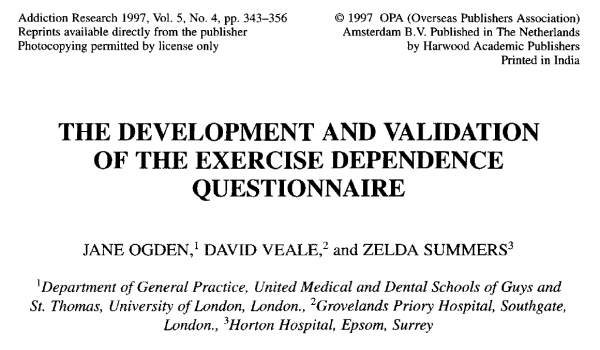
The Exercise Dependence Questionnaire (EDQ) was designed to measure the severity of dependence on exercise. To calculate the total EDQ score, all items are summed (there are no reverse items). Total scores for each of the 8 factors can also be calculated. The EDQ has not been validated against a clinical group to allow interpretation of the scores.
It can be used without my permission so long as you cite it in any publication.
Download the Exercise Dependence Questionnaire
References
Ogden, J, Veale, D, Summers, Z (1997) Development and validation of the exercise dependence questionnaire. Addiction Research, 1997; 5: 343-356. http://dx.doi.org/10.3109/16066359709004348